

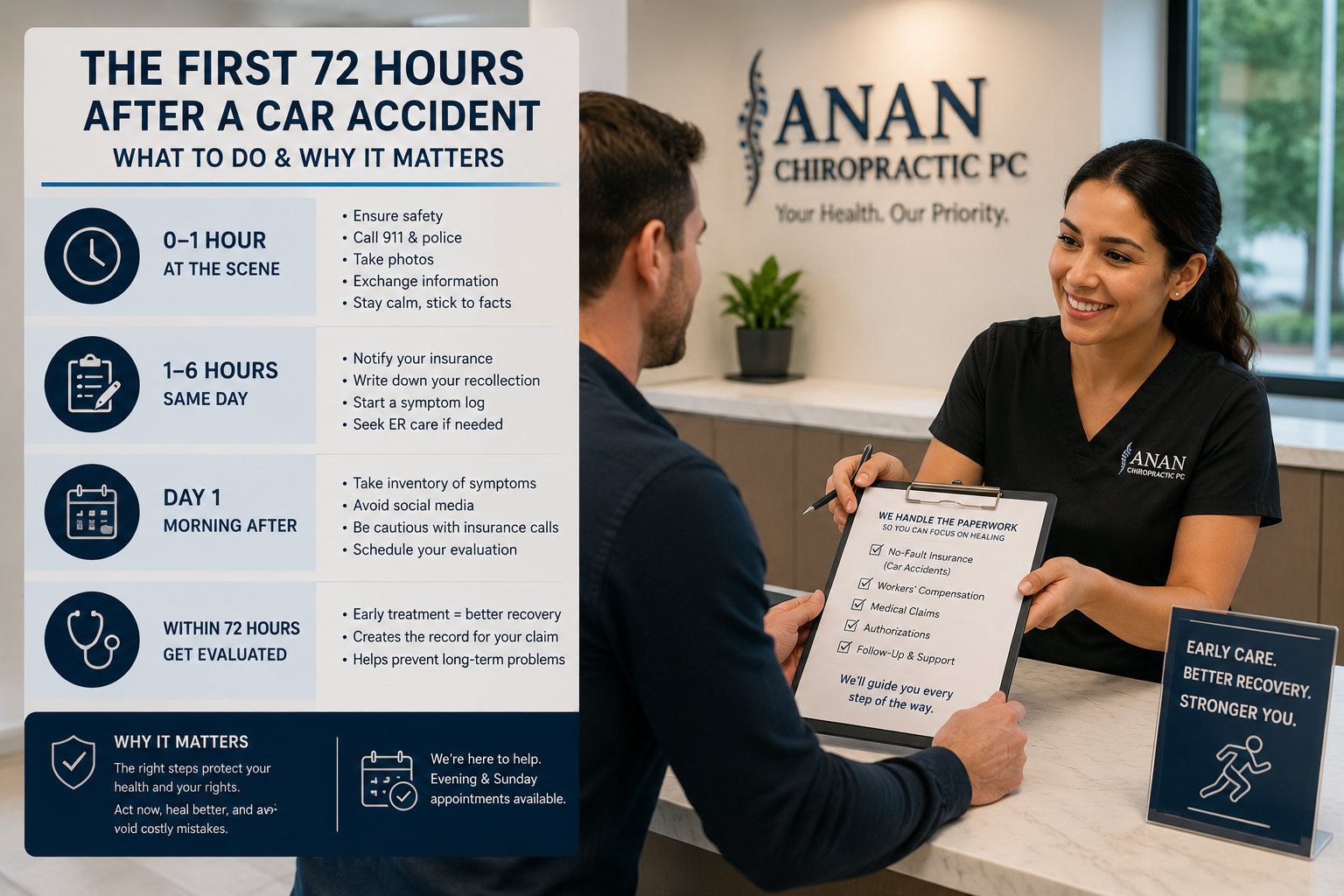

This article is written to be read twice. Once now, calmly, so the steps live somewhere in your memory. And once from the shoulder of the Southern State or the parking lot off Sunrise Highway, hands still shaking, when you need the steps and cannot think of a single one. Because that is the truth about the minutes after a crash: your brain is trying to do a hundred things at once, and the fog is precisely why checklists exist.
The first 72 hours after a Long Island car accident decide two separate stories at the same time. Your body’s story, because the injuries that matter most, whiplash, soft tissue damage, disc irritation, commonly stay silent for one to three days while adrenaline runs the show. And your claim’s story, because New York’s no-fault system pays for your recovery generously and punctually, but only for the people who take the right steps in the right order. Here is the whole playbook, hour by hour, from a clinic that treats these cases every single day.
The scene has exactly five jobs, in this order.
First, safety: check yourself and your passengers, move to a safe spot if the vehicles are drivable, and call 911 for anyone injured.
Second, the report: call the police even for a crash that feels minor, because the police report becomes the backbone of every insurance conversation that follows, and a fender bender with no report is a fender bender the other driver can later remember very differently.
Third, the photographs: shoot everything with your phone, all vehicles from multiple angles, license plates, the road and traffic signs, skid marks, weather, your visible injuries, and the other driver’s license and insurance card. Evidence is at its most honest in the first twenty minutes and gets harder to collect every hour afterward.
Fourth, the exchange: name, phone, insurance company, and policy number from every driver involved, and a name and number from any witness, because witnesses leave fast and take their version of events with them.
Fifth, the silence: exchange facts, not opinions. Do not apologize, do not assign blame, do not announce that you feel fine, because adrenaline is not a doctor and the sentence I am okay has a long memory in an insurance file.
Home, or the tow lot, or the urgent care, the first hours after the scene carry three more jobs. Notify your own insurance company that the accident happened; most policies require prompt notice, and telling your insurer is a policy obligation, not an admission of anything. Write down your account of the crash while it is fresh: the time, the direction, the lane, what you saw and heard, because memory softens fast and your written note from hour three will outrank anyone’s recollection from week three. And begin the symptom log, a note on your phone where you record everything you feel, however small: the tight shoulder, the dull headache, the knee that tapped the dash. In an insurance governed case, an unrecorded symptom is a symptom that officially never happened, and the log you start tonight is the record your recovery leans on later.
If anything feels seriously wrong at any point, severe headache, confusion, loss of consciousness at the scene, difficulty breathing, or any numbness spreading through a limb, the emergency room comes before every item on this list. Hospitals rule out the dangerous injuries. Everything else on this page is for after that question is answered.
Wake up slowly and take inventory, because this is often the morning the crash introduces itself properly. Stiffness in the neck, a headache blooming at the base of the skull, soreness across the lower back where the seatbelt did its violent, life saving work: these are the classic day one arrivals, and their late appearance does not make them minor. It makes them typical. Update the symptom log with everything, and resist the two classic day one mistakes. Do not post about the accident on social media, because insurers review public posts and a smiling photo captioned all good can resurface months later next to your injury claim. And if the other driver’s insurance company calls, and they often call fast and friendly, you are allowed to say that you are not ready to give any recorded statement and will follow up after you have been medically evaluated. Politeness and caution can share a sentence.
Day one is also the right day to book the evaluation, and on Long Island the practical excuse is gone: a clinic built for accident cases holds evening hours through the week and Sunday hours from 9 to 5, which means the appointment fits around the job the crash already complicated.
The medical consensus and the insurance reality point at the same number: get professionally evaluated within 72 hours of the crash, even if you feel fine, and especially if you only feel almost fine. The clinical reason is that soft tissue injuries treated early heal faster and more completely, before guarded muscles stiffen into patterns that take months to undo. The record reason is just as heavy: an evaluation inside the window creates the clean line connecting the crash to the injuries, before an insurance adjuster gets to suggest the pain came from somewhere else. Gaps between accident and treatment are the single favorite argument of every carrier that ever denied a claim.
What the evaluation should look like matters too. A proper accident workup takes the full history of the crash, examines movement, strength, and nerve function, and explains the findings and the plan in plain language, including exactly how the insurance side will be handled. At Well Being Chiropractic PC on Sunrise Highway, that first consultation is free, the clinic’s core specialty is precisely these no-fault and workers’ compensation cases, and the full picture of how care unfolds afterward lives on our car accident injury treatment in Rockville Centre NY page. Coordinated care matters for these injuries because they are never one problem: chiropractic care restores what the impact jammed, physical therapy rebuilds what the guarding weakened, and acupuncture reaches the pain between, all under one roof and one plan.
With the evaluation done, two pieces of paperwork close out the checklist, and both carry real clocks. The no-fault application, generally Form NF-2, must reach the applicable insurance carrier within 30 days of the accident to preserve the coverage that pays for your treatment, your medication, and a portion of lost wages, regardless of who caused the crash. File it the first week, not the fourth, because day 31 is one of the most expensive days in New York insurance. And the DMV crash report, New York’s Form MV-104, is generally required from every driver within 10 days when anyone was injured or the property damage exceeds a thousand dollars, a threshold nearly every real collision clears. Neither form requires a lawyer to complete, and a clinic fluent in these cases will point you to both, verify your coverage on the first call, and bill the no-fault carrier directly, which is the phrase that means covered treatment produces no bills with your name on them.
From there, the checklist hands off to the only habit that finishes the job: consistency. Keep every appointment through the full plan, not just until the pain quiets, because tissue that stopped hurting has not necessarily finished healing, and in a claim file, a gap in visits reads like a gap in the injury.
Read once more, in order, and save it. At the scene: safety, police, photographs, information exchange, and no opinions about fault or health. Same day: notify your insurer, write your account, start the symptom log. Day one: log everything new, stay off social media about the crash, decline recorded statements until after evaluation. By hour 72: complete a professional evaluation, free at clinics built for accident care, with evening and Sunday availability removing the scheduling excuse. First week: file the NF-2 within its 30 day window, file the MV-104 within 10 days when required, and let a no-fault fluent clinic verify coverage and bill the carrier directly. Then: attend everything, finish the plan, heal completely.
The ER comes first for red flags: loss of consciousness, severe headache, confusion, difficulty breathing, or spreading numbness or weakness. Once dangerous injuries are ruled out, or if the crash produced the typical soreness and stiffness picture, a professional evaluation at an accident focused clinic within 72 hours is the right next step.
Get evaluated anyway. Whiplash and soft tissue symptoms commonly surface 24 to 72 hours after impact while adrenaline masks them, and an early evaluation both catches what you cannot feel yet and creates the record that protects any claim you may need later.
The no-fault application, generally Form NF-2, must reach the applicable insurance carrier within 30 days of the crash to preserve the benefits that pay for medical treatment and a portion of lost wages regardless of fault. Filing during the first week is the safe habit.
All vehicles from multiple angles, license plates, the road, signs and signals, skid marks, weather conditions, your visible injuries, and the other driver’s license and insurance card, plus a name and phone number from any witness before they leave.
Yes. Medically necessary chiropractic care, physical therapy, and related treatment for accident injuries are covered under New York no-fault regardless of who caused the crash, no referral is needed for an evaluation, and clinics that bill carriers directly leave covered patients with nothing to pay out of pocket.

Well Being office is great! I dragged a box of files at work and started having lot of back pain, i went to my regular Dr and he started doing x-trays and giving me drugs for the pain. Every day i was feeling worse and told a co-worker that i did not know what to do anymore because I keep going to my regular Doctor but he was not helping me, so she tells me i will give you a Chiropractors name that helped me b4 with my back pain just in case you want to go. i went to them and it was worth to go, with 4 visits i was able to go back to normal activities, i had my last visit yesterday and i hope to continue feeling as good.

A friend of mine recommended me to this place and I'm so glad she did. I street parked and shuffled my way to this clinic but I'm out now strutting back to my car. I was impressed how Dr. Goldshteyn knew my left was tense and limited in mobility with just a touch. When I woke up this morning in a great deal of pain the first thing I told my husband was that my left side felt like a 2x4 was stapled along the spine. The doc has some magic hands! No I'm not getting a free soda with my meal, nor did they ask me to write a review, this is a legit recommendation! If you have back issues give this place a try!

I have recently become a patient at Well-being Chiropractic, in a great deal of pain initially but now being treated by their doctors and I have been feeling much better. The multidisciplinary treatments of physical therapy, accupuncture and chiropractic medicine offered have improved my overall health. I feel cared about by the staff and individual treatment, time and patience given to me. The facility is pristine, inviting and comfortable. The office staff is helpful, friendly and organized. I highly recommend this facility and Dr Goldshteyn , she is kind, supportive, knowledgeable and professional.

I'm 37 and when I first came to Dr. Goldshteyn I had a strange tingling sensation down my left arm and leg. I had trouble sleeping, sitting - anything that required me to be in the same position for longer than an hour. I expected to come for the occasional adjustment, and was taken aback when she recommended a treatment plan. But I'm glad I followed his plan. After 6 weeks the tingling sensation has nearly subsided and her recommendations have completely changed my life for the better.